





Mastering Crown Reduction Services
Mastering Crown Reduction Services
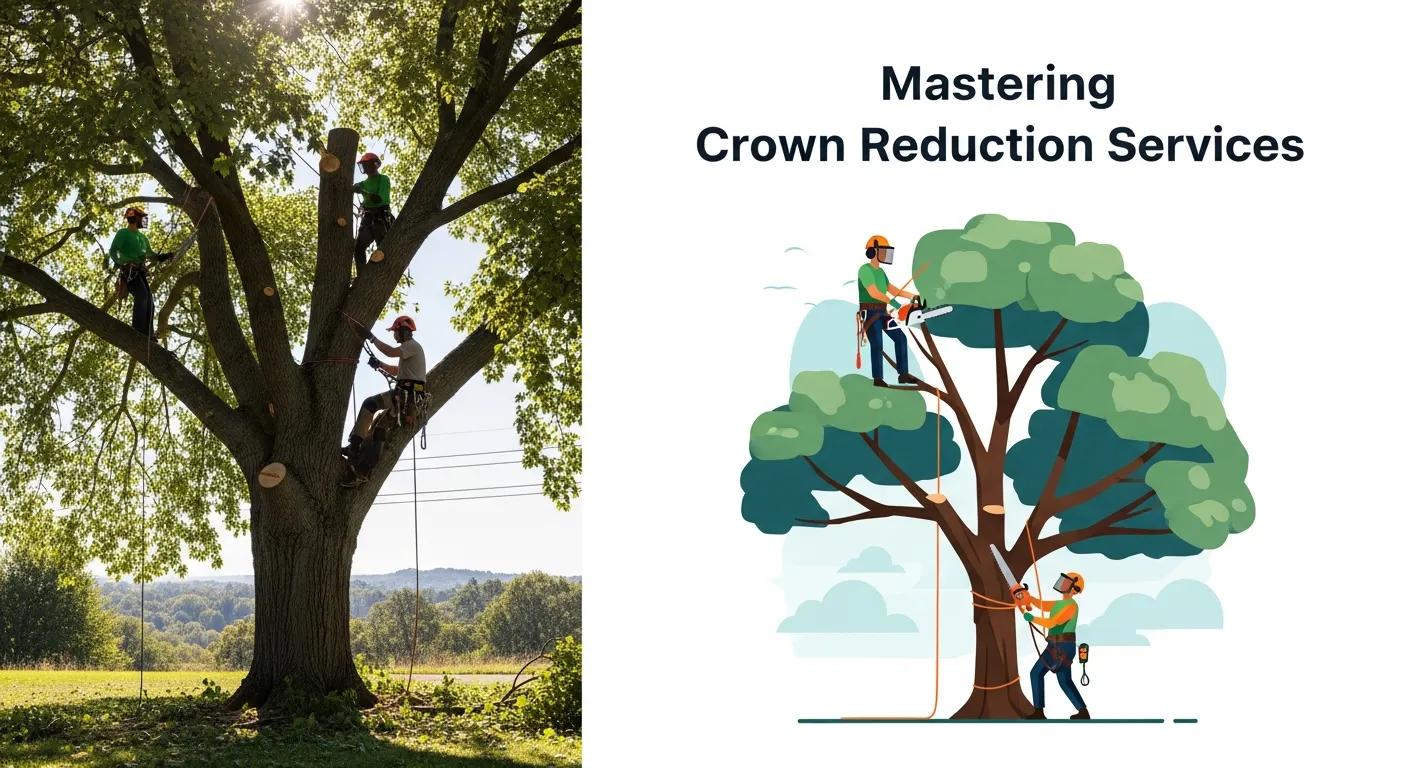
Crown reduction is a vital arboricultural practice that involves selectively trimming the upper branches of trees to reduce their size and weight. This service not only enhances the aesthetic appeal of trees but also plays a crucial role in maintaining tree health, safety, and stability, especially in urban environments. Understanding the different types of crown reduction services, their pricing, and the factors influencing these services can help property owners make informed decisions about tree care.
Different crown reduction services offer distinct benefits and pricing structures. The classification of arboricultural services often hinges on the investment required, which influences both service type and pricing.
Classifying Arboricultural Service Types & Investment The type of service influences the choice of marketing strategies and tactics. What may be appropriate for one type of service may not be for another. There are many different ways to classify services. One method is based on the investment needed to provide the service (4). The investment includes training as well as the cost of equipment. Using this approach our industry can be divided into three service types; removal, pruning and Marketing Arboricultural Services1, J Ball, 1992
Crown reduction services can be broadly categorized based on their complexity and pricing:
Basic Crown Reduction: Typically priced between $150 and $400, this service involves standard trimming suitable for small to medium-sized trees. It focuses on maintaining tree shape and removing minor branches.
Advanced Crown Reduction: Ranging from $400 to $1,000, this comprehensive trimming is designed for larger trees with complex structures, requiring more skill and equipment.
Emergency Crown Reduction: Priced at $1,000 to $1,500 or more, this urgent service addresses hazardous trees that pose immediate risks, necessitating prompt and careful intervention.
For instance, the critical role of crown reduction in addressing hazardous trees is a key aspect of specialized services.
Crown Reduction for Hazardous Tree StabilityCrown reduction pruning or pruning to stimulate crown regrowth, are both important procedures for improving the stability of hazardous trees. The protection of urban trees and the perceived safety hazard, E Rosłon-Szeryńska, 2013
Furthermore, accurately estimating and pricing such diverse tree care jobs presents unique challenges that require systematic approaches.
Estimating & Pricing Diverse Tree Care Jobs Tree care, pruning and removal operations have been difficult to price because each tree, each location, and each situation is different. Traditionally, tree care sales people have learned to estimate jobs by the trial and error method. The concept of pricing using fixed and variable factors for the different tasks can accommodate the differences in trees, locations, and situations. The system can, and should be modified to each company’s operations. The use of man-hours required to perform specific tree care operations provides the key to calculating costs and also provides a measurable basis to evaluate crew performance. Estimating and pricing tree care jobs, 1987
This overview of crown reduction services helps clients understand the options available and select the best fit for their specific tree care needs.
Frequently Asked Questions
What factors influence the cost of crown reduction services?
Costs are influenced by the tree's size and species, the complexity of the job, and the site's access and location. Larger trees or those with complex structures require more time and specialized equipment, which increases price. Emergency work for hazardous trees commands a premium because of the urgency and risk. Experience and certifications of the arborist, plus any additional services required, also affect final pricing.
How often should crown reduction be performed on trees?
Crown reduction frequency depends on the tree and its surroundings. Assess trees every few years, especially in urban settings or near structures. Health, growth rate, and site conditions determine timing. Regular maintenance keeps trees stable and reduces hazard risk. A certified arborist can recommend a schedule tailored to each tree.
What are the benefits of crown reduction for tree health?
Crown reduction improves light penetration and air circulation, which can boost photosynthesis and lower disease risk. Selective branch removal helps maintain structural integrity and reduces the chance of falling limbs. The practice can also stimulate new growth and rejuvenate older trees, contributing to a healthier canopy and long-term stability.
Are there any risks associated with crown reduction?
Yes—incorrect techniques or excessive removal can stress trees, increase vulnerability to pests and disease, and cause structural problems or dieback. To minimize risk, hire a qualified arborist who uses appropriate methods and timing. Proper planning and execution are essential to protect tree health and safety.
What should I look for when hiring an arborist for crown reduction?
Check qualifications, experience, and reputation. Certifications from recognized bodies (for example, the International Society of Arboriculture) indicate expertise. Read reviews and ask for references to assess reliability and work quality. Discuss the arborist's approach to crown reduction and confirm they follow industry best practices to protect tree health.
Can crown reduction be done at any time of the year?
It is generally best performed during dormancy (late winter to early spring) to minimize stress and disease risk. If a tree presents an immediate hazard, emergency crown reduction may be necessary regardless of season. Consult a professional to determine the optimal timing for your tree species and situation.
